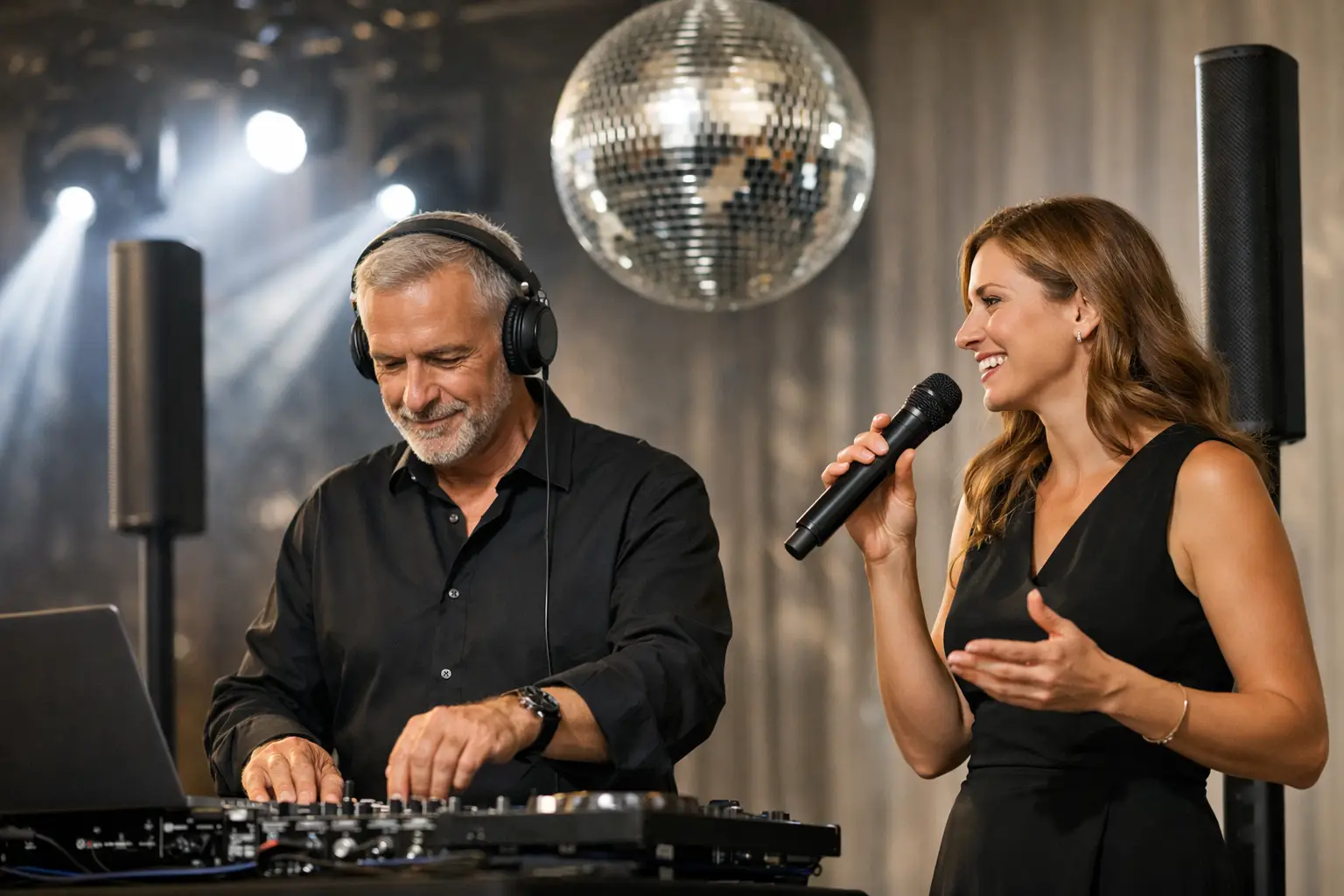

How to Coordinate DJ and MC at Your Event
A packed dance floor can be won or lost in the seconds between an MC finishing an announcement and the DJ starting the right track. Knowing how to coordinate DJ and MC duties gives your event a confident rhythm: guests know where to be, key moments land properly, and nobody is left wondering what happens next.
Whether you are planning a wedding reception, corporate gala, birthday or community celebration, the DJ and MC should work as one entertainment team. Their jobs are different, but their timing needs to be tightly aligned. The MC guides the room with clear communication and personality. The DJ controls the music, microphones, sound levels and energy. When both roles are planned well, your event feels polished without feeling over-scripted.
Start with clear DJ and MC responsibilities
The first step is deciding who owns each job. Problems usually begin when both people assume the other will handle an announcement, cue a walk-on song or organise the bridal party.
Your MC is the voice of the event. They welcome guests, introduce speakers, explain what is happening next, manage formalities and keep people moving at the right time. A good MC reads the room and speaks with enough warmth and confidence to hold attention without turning every moment into a long speech.
Your DJ is responsible for the sound and atmosphere. That includes playing entrance music at exactly the right moment, fading background music for speeches, bringing up walk-on tracks, managing microphones and choosing music that suits the audience. At larger events, the DJ may also coordinate lighting changes, photo booth timing or technical support around key moments.
There can be some overlap. Many professional DJs are comfortable hosting or making brief announcements, while some MCs have strong ideas about music. That is fine, provided one person has final responsibility for each moment. Agree on that before the event, not while guests are waiting.
How to coordinate DJ and MC with a run sheet
A detailed but flexible run sheet is the backbone of DJ and MC coordination. It should show the order of the event, the estimated time for each activity, who is involved and what music or microphone support is needed.
For a wedding, this could include guest arrival, the couple’s entrance, dinner service, speeches, cake cutting, first dance, parent dances, bouquet toss and open dancing. For a corporate event, it may cover guest registration, welcome remarks, presenter walk-ons, award stings, meal breaks, entertainment and closing remarks.
Do not just write “speech” or “entrance” on the schedule. Add the useful details. Note the speaker’s name, the preferred pronunciation, whether they need a handheld microphone or lectern mic, the exact track for an entrance and whether the DJ should fade music quickly or let it play through. These details prevent awkward pauses and rushed decisions.
Give both the DJ and MC the final run sheet well before the function. A planning call or meeting is worthwhile for major events, especially when there are several speakers, cultural traditions, live performers or complex lighting requirements. On the day, allow for changes. Dinner may run late, a speaker may be missing, or guests may need more time to return from the bar. A strong team adjusts without making the room feel the pressure.
Build in realistic timing
A run sheet should guide the event, not make it feel like a train timetable. Allow a little breathing room between formalities so guests can finish conversations, use the facilities or collect a drink. If the MC calls everyone back too abruptly, the energy can drop. If they wait too long, people lose focus.
The DJ can help manage these transitions with the right background music. Softer tracks work well while guests are seated for dinner or preparing for speeches. A more recognisable, upbeat track can signal that it is time to gather for an entrance, award presentation or dance floor moment.
Agree on cues before guests arrive
The best coordination is often invisible. The MC should never need to wave across the room or shout, “DJ, can you play that song now?” Establish simple cues during set-up and soundcheck instead.
A hand signal may be enough for a small party, but a private cue system is better for weddings and corporate functions. This could be a quick check-in near the DJ booth, a message through a designated event coordinator, or a discreet signal agreed in advance. The DJ should know when the MC is about to finish an announcement, and the MC should know how much time the DJ needs to prepare a track or change microphone settings.
For key moments, rehearse the sequence in plain language. For example: the MC introduces the bridal party, pauses at the end of the sentence, the DJ starts the entrance song, and the MC stays off the microphone while the group enters. Once everyone is in place, the DJ lowers the track and the MC continues. It sounds simple because it is simple – provided everyone has discussed it beforehand.
Check every microphone and music cue
Microphone problems are disruptive, particularly during vows, speeches and awards. Test every microphone where it will be used, not only at the DJ table. Check batteries, range, volume and feedback. If there are multiple speakers, make sure they understand how close to hold the microphone and where to stand.
Music needs the same care. Send special song requests in advance and confirm the correct versions. A first-dance song may have an acoustic version, radio edit or live recording with a different opening. An awards sting might need to start from a specific point. The DJ should have these details ready, along with a backup option if a requested track cannot be played as expected.
Match announcements to the room’s energy
An MC sets the tone, but they should not compete with the DJ or dominate the event. Short, purposeful announcements work better than lengthy commentary. Guests need to know what is happening, where to go and when to pay attention. They do not need every transition explained in detail.
The DJ can support the MC by choosing music that matches the message. A quiet instrumental bed can add polish to a sponsor acknowledgement or award announcement. A high-energy track can build anticipation before a winner is called or a milestone guest enters the room. For a formal wedding speech, silence is often the right choice once the speaker begins.
It also depends on the audience. A relaxed birthday crowd may enjoy a playful MC and big singalong entrances. A corporate audience often responds better to concise announcements, clean walk-on music and sharp timing. Community events may need more practical direction around safety, stalls, activities or sponsors. The right approach is not about being louder. It is about reading the occasion.
Plan the handover into dancing
The transition from formalities to dancing is where DJ and MC teamwork becomes especially valuable. Guests will not automatically fill the dance floor just because dinner is over. They need an invitation, a reason to join in and music that feels right for the room.
The MC can create that invitation by gathering the right people for a first dance, group dance or special moment. The DJ then takes over with a track that suits the crowd, watches how guests respond and builds from there. If only a handful of people are dancing, it may be better to play familiar floor-fillers and invite broader participation rather than jumping straight into niche requests.
Avoid an abrupt switch from a serious speech to a club-style banger unless that is exactly what the hosts want. A well-timed announcement, a short music build and a clear first song make the change feel natural. Once the floor is moving, the MC should generally step back and let the DJ maintain momentum.
Keep one person in charge of last-minute changes
Events change quickly. A photographer may need five more minutes. The caterer may ask to delay speeches. A keynote speaker may arrive late. If every family member, colleague or vendor gives separate directions to the DJ and MC, confusion follows.
Nominate one decision-maker for the event. This may be the couple, wedding planner, event organiser or a trusted member of the wedding party. The MC and DJ should know who can approve timing changes, surprise speeches and programme adjustments.
It is also wise to set boundaries around unexpected requests. A surprise performance can be a highlight, but it needs enough notice for microphones, backing tracks and stage space. A last-minute speech may be welcome, but not if it pushes dinner service back or cuts into an agreed entertainment feature. Professional coordination means being flexible while protecting the flow of the event.
Choose an entertainment team that communicates
The simplest way to reduce planning pressure is to book entertainment professionals who are used to working together. A DJ who understands hosting, sound production and event timing can anticipate what the MC needs. An MC who understands music cues knows when to give the DJ space to create the moment.
For Tasmania events, AAA Mobile DJ Services can provide DJ entertainment, experienced MC hosting, sound support, lighting and guest experiences through one coordinated team. That means fewer suppliers to brief and a clearer plan from guest arrival through to the final song.
Give your DJ and MC a shared plan, a few clear cues and the freedom to respond to the room. Your guests will remember the laughter, speeches and dancing – not the careful coordination that made every moment land.