Party Speaker Placement for Clearer, Better Sound
A great playlist cannot fix poor party speaker placement. Put speakers in the wrong corner, aim them at a hard wall, or block them with guests, and music becomes muddy while speeches turn into a guessing game. Get the layout right from the start and every announcement, first dance and party anthem reaches the room with the energy it deserves.
For weddings, birthday celebrations, corporate functions and community events, speaker position shapes more than volume. It affects how comfortable guests feel while chatting, whether the MC can keep the program moving, and how naturally the dance floor builds later in the night. The goal is not to make every part of the venue equally loud. It is to deliver clear, even sound where it matters without overwhelming guests who are seated nearby.
Start With the Room, Not the Equipment
Every venue has its own acoustic personality. A carpeted function room with curtains and soft furnishings absorbs sound differently from a bright hall with timber floors, glass doors and exposed walls. A marquee may look open and simple, but its canvas sides, low roofline and outdoor noise can create their own challenges.
Before placing a single speaker, consider where people will sit, stand, eat, mingle and dance. Identify the key areas: the ceremony or presentation space, guest tables, the dance floor, bar, entry point and any quiet zones. This quick assessment prevents the common mistake of setting speakers where there is a convenient power point rather than where the sound needs to go.
The position of the DJ or entertainment area also matters. It should provide a clear view of the room and the main moments, such as the bridal party entrance, speeches or awards. That visibility helps the DJ and MC respond to the crowd, make clean announcements and manage the pace of the event.
Aim Sound at People, Not Surfaces
Speakers are designed to project sound forward. Point them towards the audience, not across a wall, into a window, or directly at a low ceiling. Sound bouncing from hard surfaces arrives at different times, reducing clarity and making vocals harder to understand.
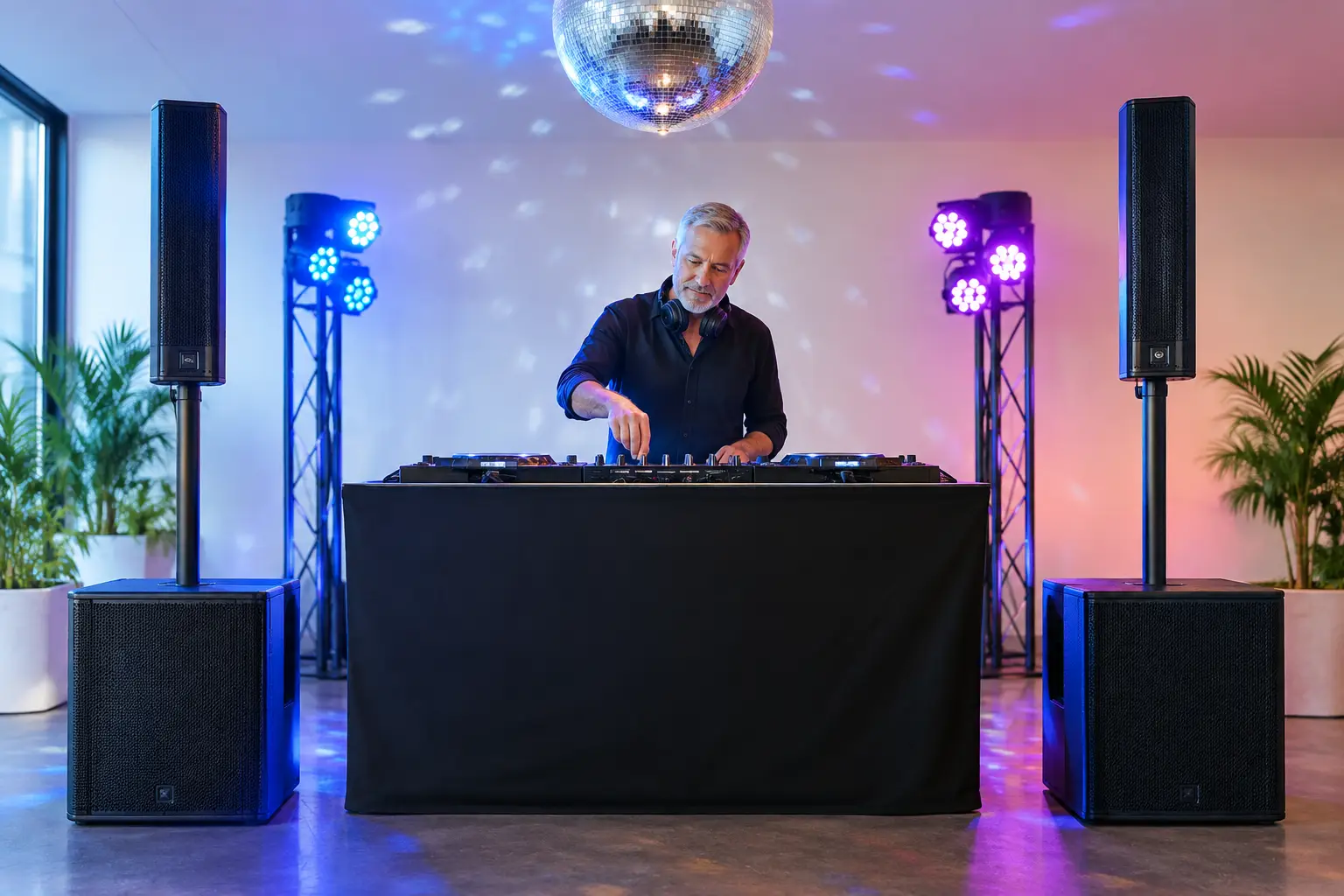
Where possible, raise full-range speakers on stable stands so the high-frequency drivers sit above head height. This allows sound to travel over the front row instead of hitting people closest to the speaker at full force while leaving guests at the back struggling to hear. The exact height depends on the room and speaker type, but the principle is consistent: coverage should be broad and controlled.
Angle the speakers slightly inward towards the main listening area. In a rectangular room, this often means placing a speaker on each side of the dance floor or presentation area and directing them into the centre of the guest space. Avoid pointing two speakers straight at each other, as their overlapping sound can become uneven.
Party Speaker Placement for Speeches and Music
A reception or party has different sound requirements throughout the night. During dinner and speeches, guests need clear voice reproduction at a sensible level. Once the formalities are complete, the focus shifts to a lively dance floor with music that feels full and exciting. Smart party speaker placement supports both without a complete room reset.
For speeches, place the main speakers ahead of the microphone position whenever the layout allows. A microphone pointed towards a speaker is far more likely to create feedback – that sharp squeal no host wants during a heartfelt toast. Keeping speakers in front of the presenter and microphones behind them gives the sound technician more gain before feedback and clearer speech for guests.
If the head table is at one end of the room, speakers can be positioned to cover the guest tables while remaining in front of the lectern or speech microphone. For a large room, additional delay speakers may be required further back. These are carefully timed so the sound feels natural rather than like an echo. They are not simply extra speakers turned up loud.
For dancing, speakers should frame the dance floor rather than fire across seated guests. This concentrates energy where the party is happening and reduces complaints from people who want to chat. Subwoofers can add warmth and impact to music, but placement is especially venue-dependent. A subwoofer in a corner may sound louder because the walls reinforce bass, yet it can also become boomy and uneven. Often, a position near the main speakers but away from tight corners produces a cleaner result.
Keep Speakers Clear of Guests and Obstacles
A speaker stack tucked behind a floral display, lounge furniture or a crowd of people might look less noticeable in photographs, but it compromises the result. Soft furnishings absorb high frequencies, while guests standing directly in front of speakers create sound shadows for the rest of the room.
Give speakers a clear path to the audience. This does not mean placing equipment in the middle of the room. It means allowing enough space around the setup and choosing positions that work with the traffic flow. In practical terms, keep sound equipment away from busy doorways, service routes, children’s activity areas and the edge of a packed dance floor where a stand could be bumped.
Safety is part of professional placement. Cables should be secured and managed neatly, speaker stands should be weighted or positioned on stable ground, and outdoor equipment needs protection from weather. For a garden wedding or waterfront celebration, wind direction and ground conditions deserve just as much attention as the view.
Match the Setup to the Event Type
There is no single speaker layout that suits every celebration. A small birthday at home may only need compact speakers aimed across the main entertaining area. A wedding for 120 guests in a reception venue needs wider coverage, speech microphones and a layout that can shift smoothly from background music to a full dance floor.
Corporate events often require the clearest speech setup of all. Presenters may move between a lectern, panel seating and a stage, while guests need to hear every word without the sound becoming tiring. In these settings, controlled volume and carefully placed microphones are usually more valuable than extra bass.
Outdoor events introduce distance and ambient noise. Wind, traffic, surf, generators and conversation can compete with the system. Speaker placement may need to bring sound closer to guests using multiple lower-volume positions rather than one powerful system at the front. This gives better clarity and is kinder to neighbouring properties and local noise restrictions.
A venue inspection or a detailed floor plan is invaluable for larger events. It reveals ceiling heights, power access, loading routes, restrictions on speaker stands and locations that may cause feedback. It also helps account for a room that will sound very different once it is filled with people.
Volume Is Not the Same as Coverage
When people at the back cannot hear, the instinct is often to turn the music up. That usually makes the front of the room uncomfortable without solving the real problem. The issue may be poor aiming, an obstructed speaker, a room with difficult acoustics or insufficient coverage for the size of the audience.
Good sound feels present but not aggressive. Guests near the dance floor should feel the music, while those at dinner tables should still be able to hold a conversation. During formal moments, voices should sound natural and easy to follow. Achieving that balance requires suitable equipment, but it also relies on thoughtful placement and active adjustment as the event changes.
Watch how guests use the space. If people are moving away from one side of the room, covering their ears near the speakers, or repeatedly asking what was said during speeches, the setup needs attention. A professional operator listens from different parts of the venue, not only from behind the DJ booth.
Common Placement Mistakes to Avoid
These issues are responsible for many disappointing sound experiences:
- Putting speakers behind the DJ and pointing them towards the booth, which increases feedback risk and reduces audience coverage.
- Setting speakers on the floor, where tables, chairs and people block sound from reaching the room.
- Aiming speakers at glass, bare walls or low ceilings, creating harsh reflections and unclear vocals.
- Placing all sound at one end of a large venue, then compensating by running the front speakers too loudly.
- Hiding equipment behind décor or placing it in a walkway where guests can obstruct or knock the setup.
The right solution depends on the venue, guest numbers, event format and available equipment. That is why an experienced DJ and sound technician will assess the room rather than relying on a standard layout every time.
For events across Tasmania, AAA Mobile DJ Services plans sound, lighting, hosting and entertainment as one coordinated experience. That means speaker positions can work with the run sheet, dance floor, photo booth area and venue layout rather than competing for space.
Your guests may never comment on the angle of a speaker stand, but they will remember hearing every toast, feeling the music lift at the right moment and staying on the dance floor long after they planned to leave. Give your sound system the same planning attention as the menu and styling, and the whole celebration will feel better from the first announcement to the final song.